
NZXT H6 Flow Manual: A Comprehensive Guide
This comprehensive guide details the NZXT H6 Flow‚ covering installation‚ cooling‚ troubleshooting‚ and maintenance‚ ensuring optimal performance.
The NZXT H6 Flow is a meticulously designed mid-tower case‚ celebrated for its exceptional airflow and sleek aesthetic. This case prioritizes efficient cooling with a focus on unobstructed pathways for optimal component temperatures. Its modern‚ minimalist design‚ often showcased in a clean white finish‚ makes it a visually appealing addition to any gaming or workstation setup.
Featuring a panoramic tempered glass side panel‚ the H6 Flow allows for a clear view of your internal components. It’s designed to accommodate a wide range of hardware‚ including advanced cooling solutions and graphics cards. The case’s dual-chamber layout simplifies cable management‚ contributing to improved airflow and a cleaner build. This manual will guide you through every step‚ from initial setup to advanced customization.
Key Features and Specifications
The NZXT H6 Flow boasts several key features‚ including optimized airflow facilitated by a perforated front panel and included NZXT F120Q fans. It supports up to three 120mm fans in the front‚ two in the top‚ and one in the rear. The case accommodates up to a 360mm radiator for liquid cooling solutions.
Specifications include a compact mid-tower form factor‚ dimensions of 465mm x 340mm x 376mm‚ and support for ATX‚ Micro-ATX‚ and Mini-ITX motherboards. It offers ample storage with two 3.5” HDD and three 2.5” SSD mounting points. The I/O panel includes USB 3.2 Gen 1 Type-A ports and combined audio/microphone jacks. Its 5V ARGB (on the RGB version) adds customizable lighting options.
Unboxing and Contents Checklist
Upon unboxing your NZXT H6 Flow‚ carefully inspect the packaging for any damage during transit. The package should include the case itself‚ three NZXT F120Q 120mm quiet airflow fans pre-installed‚ a product manual‚ and an accessory kit.
The accessory kit typically contains screws for motherboard installation‚ screws for storage devices (HDD/SSD)‚ cable ties for cable management‚ and standoffs. Verify all components are present against the included checklist within the manual. If any items are missing or damaged‚ immediately contact NZXT support for assistance and potential replacements. Retain the original packaging for potential returns or warranty claims.

Case Components Overview
The NZXT H6 Flow features a sleek design‚ panoramic glass side panel‚ and optimized airflow with pre-installed fans for superior cooling performance.
Front Panel Components
The NZXT H6 Flow’s front panel is designed for both aesthetics and functionality. It incorporates the power button‚ reset button‚ front panel I/O ports‚ and a mesh design for enhanced airflow. Specifically‚ you’ll find USB 3.2 Gen 1 Type-A ports and a USB 3.2 Gen 2 Type-C port for fast data transfer.
Additionally‚ there are combined audio jacks for headphones and a microphone. The front panel is easily removable for cleaning and access to the pre-installed fans. The mesh material minimizes dust accumulation while maximizing air intake to keep your components cool; Careful consideration went into the placement of these components for user convenience and optimal system performance.
Side Panel Installation and Removal
The NZXT H6 Flow features tempered glass side panels for showcasing your build. Removal is straightforward: locate the thumb screws at the rear of the case and loosen them. Gently slide the side panel backward‚ then lift it away from the chassis. Installation follows the reverse process – align the panel‚ slide it forward‚ and secure it with the thumb screws.
Ensure the panel is fully seated before tightening the screws to prevent gaps or rattling. The tempered glass provides excellent visibility while maintaining a secure fit. Handle the glass panel with care to avoid breakage. Proper installation ensures optimal airflow and a clean aesthetic.
Internal Layout and Components
The NZXT H6 Flow boasts a dual-chamber design‚ separating the motherboard area from the power supply and storage. This layout enhances cable management and airflow. Inside‚ you’ll find mounting points for up to two 3.6” SSDs‚ two 2.5” SSDs‚ and two 3.5” HDDs. The spacious interior accommodates large GPUs and CPU coolers;
Pre-installed are three 120mm F120Q fans for optimized airflow. Numerous routing channels are available for tidy cable management. The case supports standard ATX‚ Micro-ATX‚ and Mini-ITX motherboards. Careful component placement maximizes cooling efficiency and visual appeal within the H6 Flow’s well-designed interior.
Installation Guides
Detailed instructions are provided for motherboard‚ CPU cooler‚ GPU‚ and storage device installation‚ ensuring a smooth build process within the H6 Flow.
Motherboard Installation
Preparing for installation requires removing the side panel and locating the motherboard standoffs within the NZXT H6 Flow. Ensure the standoffs align with your motherboard’s mounting holes; additional standoffs may be needed depending on your motherboard form factor. Carefully position the motherboard‚ aligning the I/O shield with the rear panel opening.
Secure the motherboard using screws‚ ensuring a snug but not overly tight fit. Connect the front panel connectors – power button‚ reset button‚ USB‚ and audio – according to the motherboard manual. Double-check all connections before proceeding. Proper motherboard installation is crucial for system stability and functionality within the case. Refer to the NZXT documentation for specific screw types and standoff placement.
CPU Cooler Installation
CPU cooler installation within the NZXT H6 Flow demands precision. First‚ install the necessary mounting bracket onto the motherboard‚ following the cooler’s instructions. Apply thermal paste to the CPU’s integrated heat spreader – a pea-sized amount is generally sufficient. Carefully align the cooler with the mounting bracket and secure it with screws‚ tightening them in a diagonal pattern for even pressure.
Ensure the cooler is firmly seated and doesn’t wobble. Connect the CPU cooler’s fan cable to the designated CPU fan header on the motherboard. Verify compatibility with the case’s height restrictions to avoid interference with other components. Proper cooler installation is vital for maintaining optimal CPU temperatures and preventing thermal throttling.
GPU Installation
GPU installation in the NZXT H6 Flow is straightforward. Locate the PCIe x16 slot – typically the longest slot on the motherboard. Remove the corresponding rear case slot covers. Carefully align the GPU with the PCIe slot and firmly press down until it clicks into place‚ ensuring it’s fully seated. Secure the GPU to the case using screws through the rear bracket.
Connect the necessary power cables from the power supply to the GPU‚ referencing the GPU’s documentation for specific requirements. Double-check all connections for stability. Ensure sufficient clearance between the GPU and other components‚ like fans or the side panel. A properly installed GPU is crucial for optimal gaming and graphical performance.
Storage Device Installation (HDD/SSD)
Installing storage devices – HDDs or SSDs – in the NZXT H6 Flow involves locating the designated drive bays. The case supports both 2.5” and 3.5” drives. Secure the drive into the bay using screws‚ ensuring a snug fit to prevent vibrations. Connect a SATA data cable from the drive to an available SATA port on the motherboard.
Next‚ connect a SATA power cable from the power supply to the drive. Verify all connections are secure. For optimal airflow and cooling‚ consider the drive’s placement within the case. Proper installation ensures reliable data storage and system performance. Refer to your motherboard manual for SATA port locations.
Fan Installation and Configuration
NZXT H6 Flow offers versatile fan mounting options for optimized cooling. Locate the fan mounting points on the front‚ rear‚ and top of the case. Align the fan with the mounting holes and secure it using screws. Ensure the fan’s airflow direction matches your cooling needs – typically‚ intake fans pull air in‚ while exhaust fans expel hot air.
Connect the fan’s power cable to a corresponding fan header on the motherboard or a fan controller. Configure fan curves within the BIOS or using NZXT’s software to balance cooling performance and noise levels. Proper fan configuration maximizes thermal efficiency.
Front Fan Installation
Installing front fans on the NZXT H6 Flow enhances airflow and GPU cooling. Begin by removing the front panel‚ typically by pressing release buttons or unscrewing retaining mechanisms. Align the fan with the designated mounting holes on the front panel bracket. Secure the fan using the provided screws‚ ensuring a snug fit to prevent vibrations.
Connect the fan’s power cable to a 4-pin PWM fan header or a 5V ARGB header (for RGB fans) on the motherboard. Verify proper connection and orientation before reattaching the front panel. Three NZXT F120Q fans are often included for optimal front intake.
Rear Fan Installation
Rear fan installation on the NZXT H6 Flow primarily focuses on exhaust‚ removing warm air from the system. Locate the rear panel fan mounting area‚ usually pre-drilled with screw holes. Align the fan with these holes‚ ensuring the airflow direction points outwards – away from the motherboard components.
Secure the fan using the provided screws‚ tightening them firmly but carefully to avoid damaging the case or fan. Connect the fan’s power cable to a 4-pin PWM fan header on the motherboard. Confirm the connection is secure before powering on the system. Proper rear exhaust improves overall cooling efficiency.
Top Fan Installation
Top fan installation on the NZXT H6 Flow typically serves as either exhaust or intake‚ depending on your cooling configuration. Identify the top panel mounting locations‚ often supporting up to two 120mm or 140mm fans. Align the fan with the mounting points‚ ensuring correct airflow direction – either expelling hot air upwards or drawing cool air in.
Secure the fan using the included screws‚ avoiding over-tightening. Connect the fan’s power cable to a 4-pin PWM fan header on the motherboard or a fan controller. Consider dust filter placement when installing top fans to maintain system cleanliness. Proper top fan placement enhances overall thermal performance.

Connectivity and I/O
The NZXT H6 Flow features front panel I/O ports and a rear I/O layout‚ including 5V ARGB and PWM fan connections for customization.
Front Panel I/O Ports
The NZXT H6 Flow’s front panel provides convenient access to essential ports for your peripherals and devices. Typically‚ you’ll find two USB 3.2 Gen 1 Type-A ports‚ offering fast data transfer speeds for connecting external storage‚ keyboards‚ and mice. A USB 3.2 Gen 2 Type-C port is also included‚ supporting even faster transfer rates and reversible connectivity.
Additionally‚ the front panel incorporates separate headphone and microphone jacks‚ ensuring clear audio input and output for gaming‚ streaming‚ or communication. These ports are strategically placed for easy reach and accessibility‚ enhancing the overall user experience. The layout is designed for a clean aesthetic and functional convenience‚ allowing seamless integration of your essential accessories.
Rear Panel I/O Layout
The rear panel I/O of the NZXT H6 Flow is primarily dedicated to the motherboard’s connectivity options. This includes the standard array of USB ports – typically a combination of USB 2.0 and USB 3.0/3.1/3.2 Type-A ports – to accommodate a wide range of peripherals. You’ll also find audio jacks for connecting surround sound systems or headphones‚ alongside an Ethernet port for a stable wired network connection.
Video outputs‚ such as HDMI and DisplayPort‚ are present for connecting your graphics card to a monitor. PS/2 ports may also be included for legacy keyboard and mouse support. Finally‚ the rear panel houses the power connector for the power supply unit (PSU) and mounting points for expansion cards‚ like capture cards or additional network adapters.
5V ARGB and PWM Fan Connections
The NZXT H6 Flow supports both 5V Addressable RGB (ARGB) and 4-Pin PWM (Pulse Width Modulation) fans for customized cooling and aesthetics. ARGB fans‚ specifically for the Flow RGB version‚ connect to a dedicated 5V ARGB header on the motherboard‚ enabling synchronized lighting effects controlled via software. PWM fans connect to 4-Pin PWM fan headers‚ allowing for speed control based on temperature.
Proper connection is crucial for functionality. Ensure correct polarity and secure connections. NZXT emphasizes that returns are not accepted without prior approval‚ highlighting the importance of following installation instructions carefully. Incorrect wiring can damage components‚ so consult your motherboard manual for header locations.
Cooling System Details
The NZXT H6 Flow prioritizes efficient airflow with included fans and strategic mounting locations‚ optimizing thermal performance for all components.
Airflow Optimization
Optimizing airflow within the NZXT H6 Flow is crucial for maintaining optimal system temperatures. The case’s design‚ featuring a mesh front panel‚ promotes unrestricted intake of cool air. Strategically positioned fan mounts – front‚ rear‚ and top – allow for customized airflow paths.
Consider a positive pressure configuration‚ where intake fans exceed exhaust fans‚ to minimize dust accumulation. Ensure cables are neatly managed to avoid obstructing airflow. Utilizing the included NZXT fans‚ or upgrading to higher-performance models‚ can further enhance cooling efficiency. Proper component placement‚ keeping heat-generating parts away from airflow restrictions‚ also contributes to effective thermal management.
Fan Control and Management
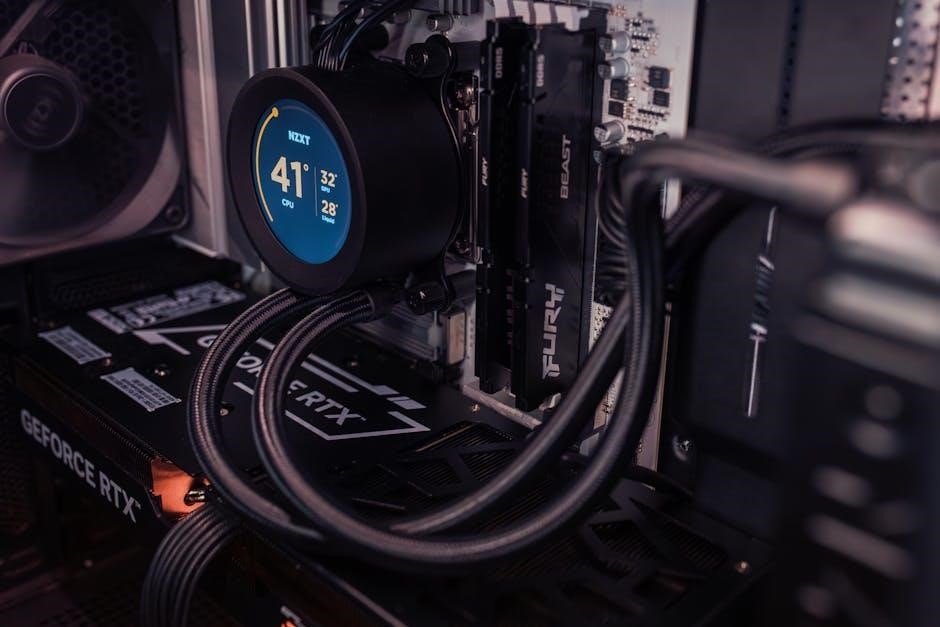
NZXT provides robust fan control options within the H6 Flow. Utilizing the motherboard’s built-in fan curves‚ accessible through the BIOS‚ allows for precise speed adjustments based on CPU and GPU temperatures. For NZXT fans‚ CAM software offers advanced control‚ including individual fan speed settings and custom fan curves.
The case supports both 4-pin PWM and 5V ARGB fans (for the RGB version)‚ enabling synchronized lighting effects. Proper fan placement and speed balancing are key to achieving optimal cooling performance and minimizing noise. Experiment with different fan configurations to find the ideal balance between thermal efficiency and acoustic comfort.
Troubleshooting Common Issues
This section addresses typical problems with the NZXT H6 Flow‚ including power supply‚ HDD/SSD installation‚ and fan noise‚ offering solutions.
Power Supply Installation Problems
Encountering issues during power supply installation within the NZXT H6 Flow? First‚ ensure the PSU is correctly oriented and aligned with the mounting location. Verify sufficient clearance for cables‚ preventing obstruction of airflow. Double-check all PSU connections – 24-pin ATX‚ 8/4-pin EPS‚ and PCIe – are firmly seated.
If the system fails to power on‚ inspect the PSU switch and wall outlet. A common issue involves incompatible PSU sizes; confirm your PSU fits the case dimensions. Incorrectly routed cables can also cause problems‚ so revisit cable management. NZXT advises against returns without prior approval‚ so thoroughly troubleshoot before seeking assistance. Remember to disconnect power before any internal adjustments.
HDD/SSD Installation Issues
Troubleshooting HDD/SSD installation in the NZXT H6 Flow begins with ensuring the case is powered off and unplugged. Confirm the drive is compatible with the available mounting brackets and bays. Securely fasten the drive using the provided screws‚ avoiding over-tightening. Verify SATA data and power cables are correctly connected to both the drive and motherboard.
If the drive isn’t recognized in the BIOS‚ double-check cable connections and ensure the SATA port is enabled in the BIOS settings. Incorrect boot order can also prevent detection. Consider testing with a different SATA cable or port. NZXT support resources offer detailed guidance; consult the manual for specific instructions and diagrams.
Fan Noise Troubleshooting
Addressing fan noise within the NZXT H6 Flow starts with identifying the source. Check for loose fan screws or cables vibrating against the case. Ensure fans aren’t obstructed by cables or components. Utilize the motherboard’s fan control settings (PWM) to adjust fan speeds‚ balancing cooling and noise levels. Dust accumulation can also cause noise; regularly clean fan blades and filters.
If noise persists‚ test fans individually to pinpoint the problematic unit. Consider replacing noisy fans with quieter alternatives. NZXT’s F-series fans are designed for quiet operation. Consult the manual for optimal fan placement and configuration. Proper airflow management minimizes the need for excessive fan speeds‚ reducing noise.

Maintenance and Cleaning
Regular cleaning of dust filters and the case exterior maintains optimal airflow and cooling performance within the NZXT H6 Flow chassis.
Dust Filter Cleaning
Maintaining clean dust filters is crucial for optimal airflow and component cooling within your NZXT H6 Flow case. Locate the filters on the front‚ top‚ and bottom of the case. Gently remove them by sliding or lifting‚ depending on their placement.
To clean‚ use a soft brush or compressed air to remove accumulated dust. Avoid using water or harsh cleaning chemicals‚ as these can damage the filter material. For stubborn dust‚ a gentle vacuum with a brush attachment can be employed.
Ensure the filters are completely dry before re-installing them. Regularly cleaning these filters – ideally every few months‚ or more frequently in dusty environments – will significantly improve your system’s thermal performance and longevity.
Case Exterior Cleaning
Keeping the exterior of your NZXT H6 Flow clean enhances its aesthetic appeal and prevents dust buildup around ventilation areas. Begin by disconnecting the power cable and ensuring the case is powered off. Use a soft‚ slightly damp microfiber cloth to wipe down the exterior surfaces.
Avoid abrasive cleaners or solvents‚ as they can damage the paint or glass panel. For fingerprints or smudges‚ a screen cleaner specifically designed for electronics is recommended. Pay particular attention to the tempered glass side panel‚ cleaning it gently to avoid scratches.
Regularly wiping down the exterior – approximately every month – will maintain its pristine condition and contribute to overall system cleanliness.
Warranty Information and Support
NZXT offers a warranty on the H6 Flow; returns require prior approval. Access comprehensive support resources‚ FAQs‚ and documentation on the NZXT website.
NZXT Return Policy
NZXT’s return policy requires prior approval for all returns‚ ensuring a smooth process for customers experiencing issues with their H6 Flow case. Before initiating a return‚ it’s crucial to contact NZXT support to obtain a Return Merchandise Authorization (RMA) number. This number is essential for tracking and processing your return efficiently.
The policy covers defects in materials or workmanship‚ but does not cover damage resulting from misuse‚ accidents‚ or unauthorized modifications. Original packaging and all included accessories are required for a successful return. Shipping costs for returns may be the responsibility of the customer‚ depending on the nature of the defect and warranty coverage. Detailed information regarding the return process‚ eligibility criteria‚ and warranty duration can be found on the official NZXT website.
Accessing NZXT Support Resources
NZXT provides multiple avenues for customers needing assistance with their H6 Flow case. The primary resource is the official NZXT Support website‚ offering a comprehensive FAQ section‚ troubleshooting guides‚ and downloadable manuals‚ including the H6 Flow manual itself. Users can also submit support tickets directly through the website for personalized assistance.
Furthermore‚ NZXT maintains an active community forum where users can share experiences‚ ask questions‚ and receive help from fellow enthusiasts and NZXT staff. Social media channels‚ such as Twitter and Facebook‚ provide additional avenues for quick inquiries and updates. For more complex issues‚ direct contact with NZXT’s customer support team via email or phone is available‚ ensuring comprehensive support for all H6 Flow related concerns.